
Why More European Salons Are
Switching to Vietnamese Raw Hair
Something has been quietly shifting in European hair salons over the past few years. In cities from London to Berlin to Paris, salon owners who once ordered exclusively from Indian or Brazilian suppliers are now sourcing Vietnamese raw hair — and not going back.
It’s not a trend driven by marketing. It’s driven by results.
Here’s why the switch is happening, and what makes Vietnamese raw hair different enough to change buying habits across an entire continent.
Market ContextThe European Hair Extension Market in 2026
Source: Fortune Business Insights, Human Hair Extension Market Report 2026
Demand is not the issue. Supply quality is.
European salon clients — particularly those at mid-to-high-end establishments — are increasingly knowledgeable about what they’re buying. They research. They ask questions. They notice when extensions behave differently than what was promised. This has pushed salon owners to look beyond the most common supply chains and find sources that can reliably deliver what clients are paying for.
Vietnamese raw hair has become that source for a growing number of European professionals.

European clients are more informed than ever — and demanding better results from their extensions. Photo: Unsplash
What Is “Raw” Hair — And Why Does It Matter?
Before explaining the Vietnamese advantage, it’s worth being precise about terminology — because it’s widely misused across the industry.
Raw hair — Hair collected from donors and cleaned, but not subjected to any chemical processing. No perming, relaxing, acid baths, or silicone coating.
Remy hair — Cuticles are aligned in the same direction (reduces tangling), but the hair may still have been chemically processed.
Virgin hair — A term used inconsistently across suppliers. Generally means unprocessed, but there is no standardized industry definition.
The distinction matters because only truly raw hair can be colored, bleached, and heat-styled in the way that salon-quality work demands. Processed hair — even when labeled “virgin” — will behave unpredictably under heat and chemicals.
“Only truly raw hair can be colored, bleached, and heat-styled in the way that salon-quality work demands.”
What Makes Vietnamese Hair Different
Vietnam has established a strong reputation in the global hair supply chain, and the reasons are rooted in both geography and practice.

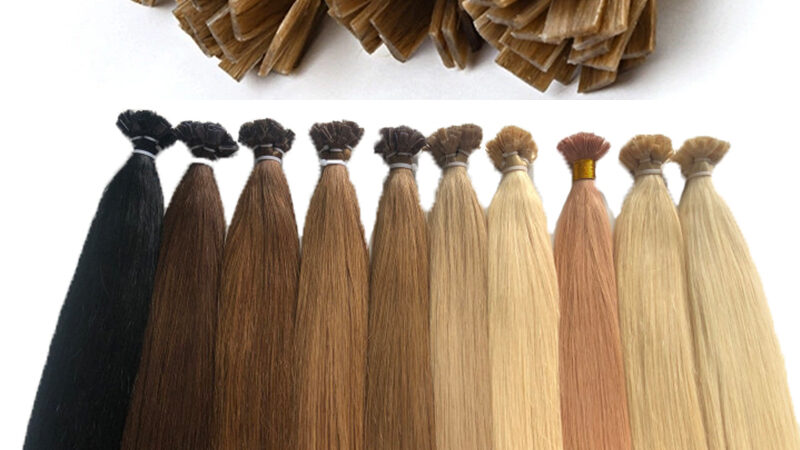
Raw Vietnamese hair — unprocessed, cuticles intact

Natural strength and texture — characteristic of Vietnamese hair
Natural Hair Characteristics
Vietnamese hair — particularly from rural regions of northern and central Vietnam — is noted for being naturally thick, strong, and smooth. The strands are dense enough to provide volume and coverage, while remaining fine enough to blend naturally with European hair textures.
Minimal Chemical Exposure
In rural Vietnamese communities, the use of commercial hair dyes, bleaches, and chemical treatments has historically been lower than in more urban populations. This means the hair collected tends to be genuinely unprocessed — a significant factor for salon professionals who need to apply color after purchase.
Cuticle Integrity
Raw Vietnamese hair retains its cuticle layer — the outermost protective structure of the hair shaft. Intact cuticles mean the hair reflects light naturally, resists tangling, and maintains its texture through washing, heat styling, and coloring. This is what gives Vietnamese hair its characteristic healthy appearance that clients respond to.
Color Versatility
Because the hair hasn’t been pre-processed, it responds to bleach and color predictably and evenly — a critical requirement for the copper, burgundy, and dimensional blonde shades trending across European salons this season.
ComparisonHow It Compares to Indian and Brazilian Hair
These comparisons are broadly accurate at the industry level, though quality varies by supplier within each origin category:
| Factor | Vietnamese Raw Hair | Indian Hair | Brazilian Hair |
|---|---|---|---|
| Processing | Truly unprocessed | Often processed | Frequently processed |
| Consistency | High — concentrated sourcing region | Variable — wide sourcing base | Variable — term often refers to texture, not origin |
| Color versatility | Excellent — lifts and tones evenly | Good if unprocessed | Depends on processing level |
| Natural texture | Naturally straight — versatile | Naturally wavy/varied | Often artificially textured |
| Cuticle integrity | Intact in raw form | Often stripped or coated | Often stripped or coated |
Indian hair is the most widely available on the global market, which makes pricing competitive but consistency variable. Vietnamese hair, sourced from a more geographically concentrated population, tends to show greater consistency in texture and quality across batches — which for salon owners who need to reorder reliably, matters considerably.
“Brazilian hair” sold commercially is often not exclusively from Brazil — the term has become more of a texture descriptor than a geographic origin. Vietnamese raw hair, by contrast, is genuinely straight at source and can be curled, waved, or left straight, offering greater versatility without dependency on a manufacturing process.
For Your BusinessThe Practical Case for European Salons

European salon owners are increasingly choosing suppliers based on quality and consistency, not just price. Photo: Unsplash
Direct Factory Pricing
The growth of international logistics and digital communication has made it possible for European salons to work directly with Vietnamese manufacturers, eliminating intermediary markups. A salon that previously bought through a European distributor of Indian hair is often now sourcing Vietnamese raw hair at a lower cost per bundle — while receiving better quality.
Transparent Sourcing
There is increasing awareness among European consumers and salon clients about ethical sourcing. Responsible Vietnamese hair suppliers work with traceable supply chains and can document where and how the hair was collected — an increasingly important factor for salons operating in markets where clients ask these questions.
Sample-First Buying
Most reputable Vietnamese raw hair suppliers offer sample orders before committing to wholesale quantities. This allows salon owners to test the product on real clients before making a full investment — a significant reduction in purchasing risk compared to traditional distribution channels.
What to Look for When Choosing a Vietnamese Supplier
Not all suppliers are equal, and “Vietnamese hair” has become a marketing term that some less scrupulous sellers apply broadly. Before committing to a new supplier, ask:
- Can they provide documentation of country of origin?
- Is the hair genuinely raw and unprocessed, or has it been treated?
- Do they offer sample orders before wholesale commitments?
- What is their policy for batches that don’t meet the agreed standard?
- How consistent is quality across multiple orders over time?
- Do they have verifiable reviews or references from other salon clients?
A supplier confident in their product will answer all of these questions directly, without deflection.
Ready to see the difference for yourself?
Indochina Hair supplies raw Vietnamese hair directly to salons and distributors across Europe. Sample orders are available, and we offer dedicated support for salon wholesale accounts. No obligation — just quality you can evaluate firsthand.
Request a Wholesale SampleSources
- Fortune Business Insights — Human Hair Extension Market Size & Growth Through 2034
- Star Hair Factory — Brazilian vs. Indian vs. Vietnamese Hair: The Complete Expert Guide
- 5S Hair — Is Vietnamese Hair Good Quality? Advantages and Disadvantages
- Sheen Hair Vietnam — Import Export Challenges and Opportunities for Vietnamese Human Hair in 2025