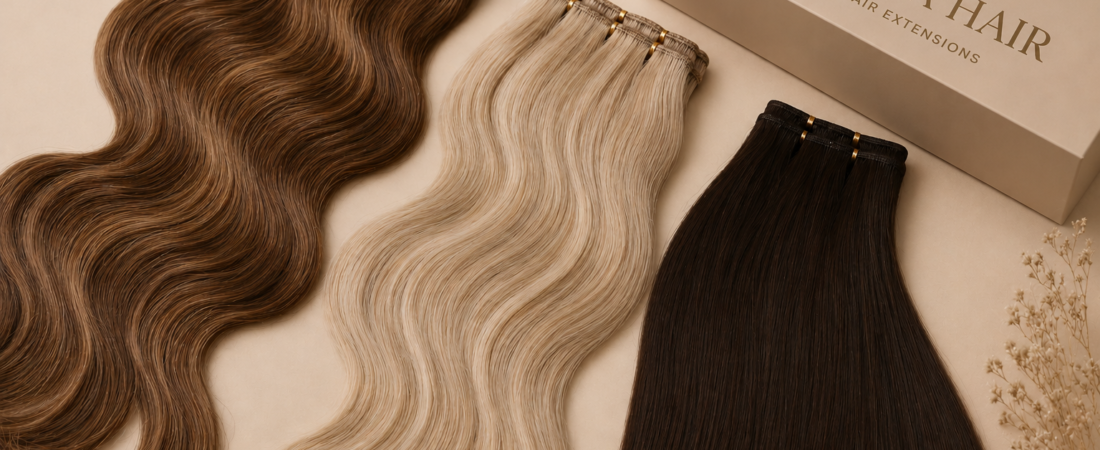

How to Spot Fake vs Real Human Hair Extensions
(7 Tests That Never Lie)
You’ve seen it happen — or maybe it’s happened to you. A set of “100% human hair” extensions that frizzes after one wash, melts under a flat iron, or never quite holds a curl. The packaging said human hair. But something was off.
The global hair extension market is riddled with mislabeled products. Extensions sold as “100% human hair” or “Remy hair” can contain synthetic fibers, mixed blends, or chemically treated hair that’s been coated with silicone to mimic the feel of virgin hair — until that coating washes off, usually within the first few weeks.
Here’s the thing: you don’t need a lab to tell the difference. These seven tests will give you the truth — before you commit to a purchase.
The Burn Test (Most Reliable)
This is the single most definitive test available, and no synthetic fiber can fake the result. The chemical composition of human hair (keratin protein) and synthetic fiber (typically modacrylic, PVC, or polyester) produces fundamentally different combustion results.
How to do it: Take 2–3 strands from the extension, hold them with tweezers over a fire-safe surface, and carefully hold a lighter flame to the ends for a few seconds.
| ✓ Real Human Hair | ✗ Synthetic / Fake | |
|---|---|---|
| Flame | Burns slowly, soft flame | Melts, may flare suddenly |
| Smell | Burning protein (like feathers) | Burning plastic or chemicals |
| Residue | Crumbles into gray ash | Hardens into a shiny black bead |
⚠ Safety note: Perform this test outdoors or in a well-ventilated area. Only burn 2–3 strands at a time, never large quantities indoors.
The Heat Styling Test

Real human hair withstands heat styling — synthetic fibers cannot. Photo: Unsplash
Real human hair can withstand heat from flat irons and curling wands, just like your natural hair. Synthetic fibers cannot — they melt.
How to do it: Set a flat iron or curling wand to 180–200°C (356–392°F). Apply it to a small section of the extensions for 5–10 seconds.
✓ Real human hair: Takes the curl or straightens smoothly. Holds the style. No unusual smell. Returns to normal after washing.
✗ Synthetic hair: Melts, fuses, or develops a damaged texture. Emits a plastic-like odor. The damaged section cannot be repaired.
The Water Test
Human hair behaves in water exactly the way your own hair does — because it’s the same material.
How to do it: Spray a section of the extension thoroughly with water and observe what happens.

Real human hair absorbs water naturally

Synthetic hair repels water or dries unusually fast
✓ Real human hair: Absorbs water readily, darkens in color when wet, becomes heavier, and air-dries in 1–3 hours depending on thickness.
✗ Synthetic hair: Repels water or takes much longer to absorb. Barely changes in appearance. Dries faster than human hair.
The Texture & Cuticle Test

Running fingers against the cuticle direction reveals whether the hair is real. Photo: Unsplash
Run your fingers slowly up a strand — from tip to root — against the natural direction of the hair.
✓ Real human hair has a slight resistance when you run fingers upward, because the cuticle scales are raised against that direction. Run from root to tip, and it’s smooth. This is the cuticle layer working as intended.
✗ Synthetic or low-quality mixed hair often feels unnaturally smooth in both directions — because there are no real cuticles, or the cuticles have been stripped and replaced with a silicone coating.
The Visual Shine Test
Hold the extensions up under natural light or bright indoor lighting and observe how the hair reflects light.

Natural human hair has a healthy, dimensional shine — not plastic-like. Photo: Unsplash
✓ Real human hair has a natural, healthy shine — reflective but not blinding. It looks like healthy hair on a real person. The shine is dimensional and changes subtly depending on the angle.
✗ Synthetic or silicone-coated hair appears uniformly, almost plastically shiny — especially under flash photography or direct sunlight. This coating is what makes cheap extensions feel soft when new but tangled and dull after the first few washes.
The Bleach Test (For Salon Professionals)
This test is particularly useful for salon owners and wholesale buyers who want to verify raw or virgin hair claims before placing a large order.
How to do it: Apply a small amount of hair bleach or developer to a section of the extensions and observe how it lifts.
✓ Real virgin human hair lifts in color consistently and evenly — the same way natural, unprocessed hair responds to bleach.
✗ Processed or coated hair may bleach unevenly, turn brassy, or resist lifting — signs that the hair has been chemically altered before it reached you.
The Price Gut Check

If a deal seems too good to be true, it almost always is. Photo: Unsplash
This one isn’t a physical test, but it’s just as important as any of the above.
Genuine raw human hair requires skilled sourcing, careful processing, and quality packaging. It cannot be produced for a few dollars per bundle. If a deal looks too good to be true — it is. If you’re seeing “100% human hair” priced similarly to synthetic alternatives, the product is almost certainly mislabeled.
Quality is priced accordingly. Anything that seems dramatically out of step with the market rate deserves serious scrutiny before purchase.
A Note on “Remy” Hair
The term Remy indicates that cuticles are aligned in the same direction, which reduces tangling. It refers to a quality standard, not necessarily to whether the hair is human or synthetic. That said, true Remy hair is always human hair. When you see the label “Remy” on a product, apply the tests above to verify the claim independently — don’t rely on the label alone.
Ready to experience the real thing?
At Indochina Hair, all our extensions are 100% raw human hair sourced directly from Vietnam — cuticles intact, zero silicone coating. We welcome sample orders so you can test quality before committing to wholesale.
Request a Sample